

The Job Costing Calculator That Pays For Itself in One Estimate
Enter your job details, get your exact cost and profit in 30 seconds - based on your overhead and profit targets, not guesswork.
Whether you're bidding a $500 repair or a $50,000 project, you'll know your number is right.
You're running a solid business. Jobs are coming in. Revenue is growing.
But here's the thing you don't talk about in the contractor groups:
Every time you sit down to write an estimate, you're spending way too long manually crunching numbers, hoping you didn't forget anything, and wondering if your price is too high or too low.
You quote the job. Hit send. And then you wait - second-guessing yourself the whole time.
"Did I leave money on the table?"
"Am I going to lose this job because I'm too expensive?"
"When's the last time I even updated my rates?"
If that sounds familiar, keep reading.
You're making $10k, $30k, maybe even $100k+ a month. From the outside, you've made it.
But here's what's actually happening:
You're spending way too long on every estimate - when you could be out closing jobs or building the business
You're basing your prices on "what you charged last time" - even though your costs have gone up and your overhead has doubled
You don't know your exact profit on each job until AFTER it's done - once you've caught up on accounting and realized you made way less than you thought
You see your competitor's price come in way lower and think "how are they doing it that cheap? Am I missing something?"
Or worse - you lose the job and wonder "was I too expensive? Should I have gone lower?"
You can't delegate estimating because you don't have a system anyone else could follow - so it all bottlenecks on you
You're winging it based on gut feel, past jobs, or what you think the market will bear
And the worst part?
You know you should have a real system for this. But building one from scratch would take dozens of hours you don't have.
So you keep doing it the same way. Hoping your prices are right. Hoping you're not leaving money on the table. Hoping you're not pricing yourself out of jobs.
There's a better way.
This isn't another template you download and never use.
Swamped was built by people who've actually run the businesses you're trying to scale.
Our founder didn't start with an MBA or a business degree. He started with a hammer and a truck.
Handyman work. Solo operator. Grinding 60-70 hour weeks just to keep up.
Then he built that into a fencing company doing $1M+ per year with multiple crews. Then a nationwide service company doing multiple six figures per month. Then a cleaning company. Then another regional service business. Then another nationwide company.
Here's what he learned about job costing:
When you're solo, you can wing your pricing. When you have employees and overhead, you can't.
His fencing business? He spent dozens of hours building a spreadsheet that could price any fence job in under 10 seconds with just basic info - linear feet, height, material type.
For simple jobs? That was the final price. Quote it over the phone. Send it. Done.
For complex projects? It got him within 5% of the final number - close enough to weed out tire-kickers and unqualified leads in seconds without wasting time on a site visit. Then a quick review to double-check the numbers and finalize the details.
But here's what changed everything:
It wasn't just about speed. It was about finally being able to delegate estimating.
Before the system? He was the only one who could quote jobs. Every estimate bottlenecked on him. He'd spend hours every week doing estimates when he should've been growing the business.
After the system? Anyone on his team could punch in the numbers and get an accurate price. He could finally step out of that role and focus on what actually mattered.
That's how he scaled. That's how he went from owner-operator to actual owner.
And every pricing mistake is expensive. Underbid by 15%? You just worked for free. Overbid by 20%? You lost the job. Spend all your time estimating? You're not building the business.
The system fixed all of it.
Now? He runs multiple service businesses as an actual owner, not an owner-operator. His teams handle the day-to-day. He checks in, reviews the numbers, handles big decisions. Less than an hour per day combined.
The rest of his time? Building Swamped and helping other contractors make the same transition.
That's why we built this.
Not to teach you theory. To hand you the exact system we use - so you don't have to spend dozens of hours building it yourself.
Ready to stop second-guessing your estimates?
Here's what changed everything:
You can't scale what you can't systematize.
When you're doing estimates in your head or "going off what you charged last time," you're the bottleneck. Nobody else can do it. You can't delegate it. You can't step away.
But more importantly - you're guessing.
Maybe you're guessing based on experience. Maybe you're guessing based on what your competitors charge. But you're still guessing.
And every guess costs you money - either because you left profit on the table, or because you lost the job, or just because you spent way too long doing it.
Not to mention the lead cost to get them to bid on those jobs in the first place. And the time invested to drive out there if you're doing site visits.
The solution isn't to work harder or get better at mental math.
The solution is to build a system that does the math FOR you - based on YOUR actual costs, YOUR overhead, YOUR profit targets.
Once you have that system, everything changes:
Estimating takes seconds instead of eating up your entire day
You bid with total confidence - no more second-guessing
You can defend your pricing (because you KNOW your numbers)
You can finally delegate this to someone else on your team
That's what this calculator does.
Introducing: The Job Costing Calculator
Everything you need to price jobs in 30 seconds - with confidence your numbers are right.
Here's what you're getting:
The Complete Job Costing Guide
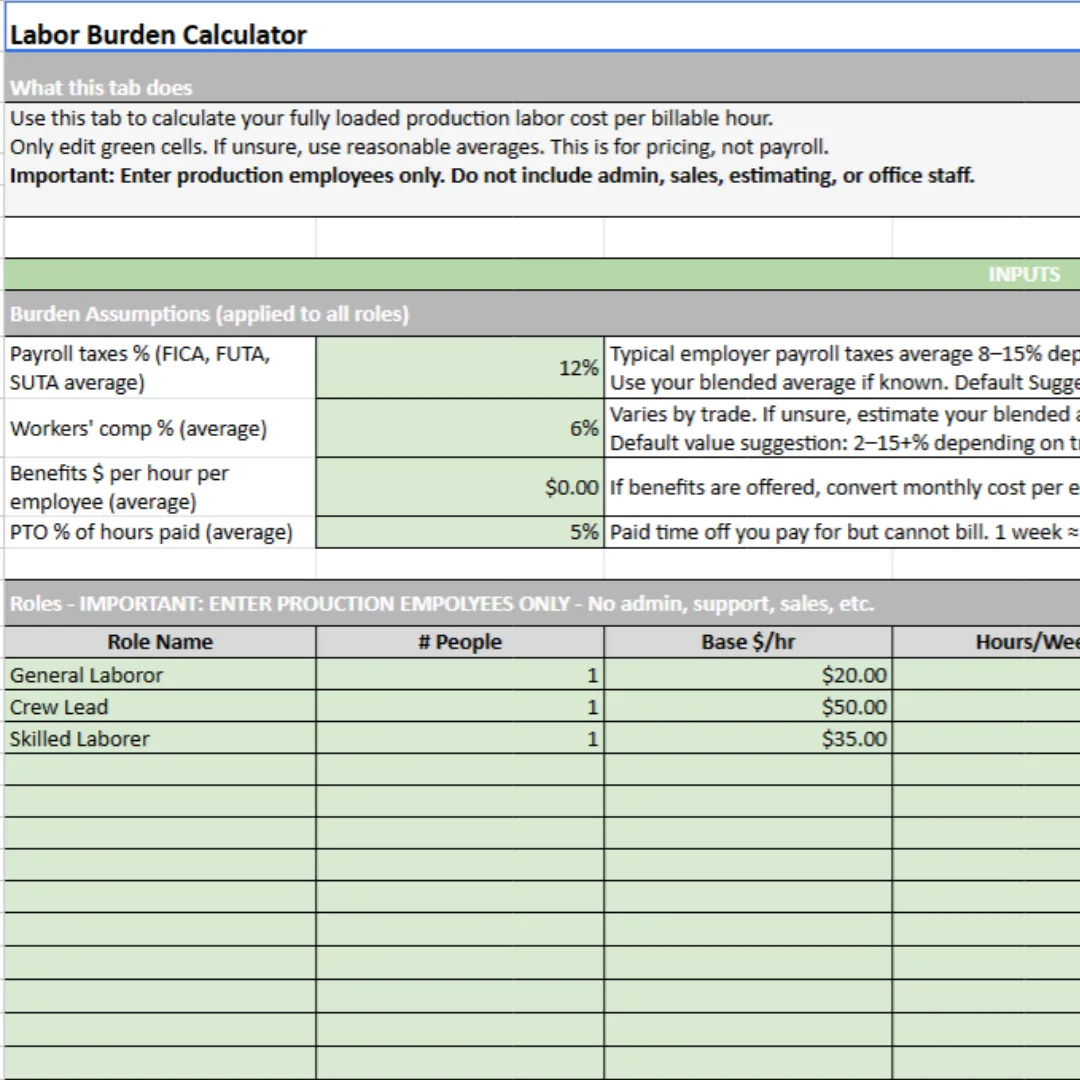
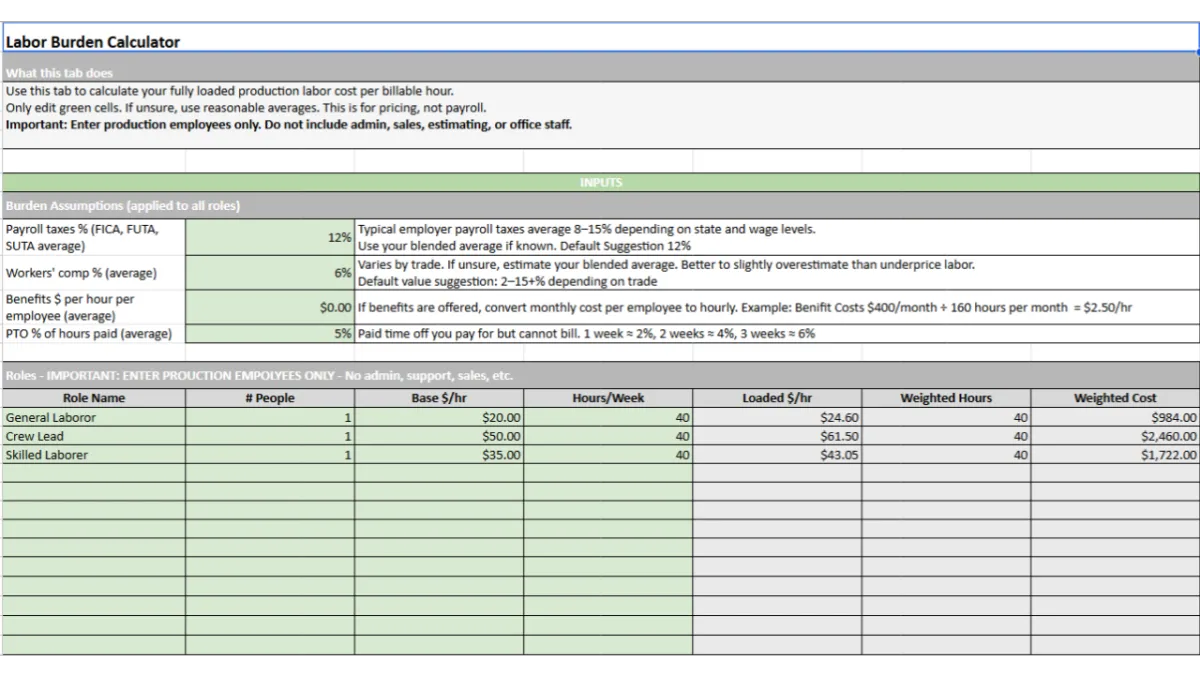
A step-by-step walkthrough that shows you how to calculate your TRUE cost per hour - including:
Labor costs (wages + burden/taxes)
Overhead (the stuff most contractors forget - rent, insurance, tools, truck payments, phone bills, software)
Material markup (how much to add to cover waste, delivery, storage)
Profit margins (what you should actually be targeting based on your business goals)
Hidden costs (drive time, callbacks, small material waste - the stuff that eats 10-15% of your margins)
You'll Learn
How to calculate your REAL cost per hour (most contractors underestimate this by 20-30%)
How to factor in overhead properly (so you're not accidentally working for free)
How to set profit targets that actually make sense for your business
How to adjust pricing based on job complexity without guessing
The Plug and Play Job Costing Calculator
Enter your business info once (labor rates, overhead, profit targets.
Then for every job:
Punch in your estimated hours + materials
Get your exact cost and profit in 30 seconds
See your break-even, your margin, your total price
Fully customizable. Adjust for your labor rates, your overhead, your profit targets. Works for any service business - fencing, concrete, roofing, decking, pole barns, HVAC, electrical, plumbing, landscaping, you name it.
Built to delegate. Anyone on your team can use this to price jobs - without you standing over their shoulder. Just plug in the numbers, get the price, done.
Simple jobs? This IS your final price. Quote it in 10 seconds.
Complex jobs? This gets you within 5% - close enough to weed out unqualified leads without wasting time on site visits. Then a quick review to finalize.
Pricing Strategy Frameworks
How to price competitively without racing to the bottom
When (and how much) to adjust your pricing as costs change
How to know your numbers so well you can confidently defend them when customers push back
Step-by-Step Setup Guide
The guide walks you through exactly how to set up the calculator for YOUR business - with detailed instructions and examples so you can hit the ground running.
Here's what this means for you:
Price jobs in a fraction of the time (instead of spending hours manually crunching numbers every week)
Know your exact profit before you even send the quote - no more waiting until the end of the month to realize you barely broke even
Defend your pricing with confidence - because you can break down exactly why you charge what you charge
Finally delegate estimating to your team - without expensive mistakes that cost you thousands
Stop leaving money on the table OR pricing yourself out of jobs - you'll be competitive AND profitable
What's this worth?
If you built this yourself: 20-40 hours of spreadsheet work + trial and error = easily $2,000+ of your time
If you hired someone to do it: $1,500-3,000 minimum
Your investment today: Just $97
(Less than what you'd lose on ONE mis-priced job)
Stop winging your estimates. Start knowing your numbers.
This is for you if:
You're doing $10k-$100k+/month and your overhead is eating into margins
You're spending way too long on every estimate and it's slowing you down
You want to delegate estimating but don't have a system anyone else can follow
You're not 100% sure your pricing is competitive OR profitable (or both)
You've lost jobs and wondered "was I too expensive?"
You've won jobs and wondered "did I leave money on the table?"
You're in a service trade where you bid jobs based on labor + materials (fencing, concrete, pole barns, roofing, decking, HVAC, electrical, plumbing, landscaping, remodeling, etc.)
This is NOT for you if:
You're brand new and haven't run any jobs yet (you need a few jobs under your belt first to understand your costs)
Your average job is under $300 (the math still works, but you probably don't need this level of detail)
Our Promise: Use This for 30 Days Risk-Free
Download the calculator. Set it up with your numbers. Use it on your next 5-10 estimates.
If it doesn't save you time, give you more confidence in your pricing, or help you win more profitable jobs - just email us within 30 days and we'll refund every penny.
No questions asked. No hoops to jump through.

We're that confident this will change how you price jobs.
Try it risk-free for 30 days. You've got nothing to lose.
WE have the answers
Frequently Asked Questions
We believe in transparency. Here are the most common questions we get:
Will this work for my type of business?
Yes. The calculator is fully customizable for any service business. Whether you're in fencing, concrete, roofing, HVAC, electrical, plumbing, decking, pole barns, landscaping, remodeling - if you're estimating jobs based on labor + materials, this works.
We've had contractors in dozens of different trades use this exact system.
I'm not great with spreadsheets. Is this complicated?
Nope. You enter your business info once (labor rates, overhead, profit targets). After that, it's just: enter estimated hours + materials → get your price.
The guide walks you through step-by-step with detailed instructions. If you can use Google Sheets or Excel at a basic level, you can use this.
What if I already have a pricing system?
Even better.
You can use this to double-check your current system and make sure you're not missing any costs.
Most business owners we talk to realize they were forgetting at least 2-3 cost categories - or have miscalculated the TRUE cost of overhead or labor burden. Leading to their margins being less than expected.
This helps you tighten up what you're already doing.
How is this different from just charging $X per hour?
Flat hourly rates typically don't account for overhead, job complexity, material markups, or profit targets.
This calculator shows you your TRUE cost per hour (including ALL overhead), then lets you adjust markup and profit based on the specific job.
You can still charge an hourly rate instead of by the project, but you'll know exactly what YOUR hourly rate should be. And it's way faster than doing all the math manually every time. You price a job or your overhead changes.
Can my team use this, or is it just for me?
It's built to delegate.
Once you set it up with your numbers, anyone on your team can use it to price jobs. That's the whole point. To get estimating off your plate so you can focus on growing the business.
You can even set it up so they can't accidentally change your base rates or profit targets. They just enter the job details and get the price.
What format is the calculator?
Google Sheets (which you can also download as Excel if you prefer).
Most contractors find Google Sheets easier because you can access it from your phone, share it with your team, and it auto-saves. But you can use it however you want.
What if my costs change or I need to update my rates?
Easy. Just update your base rates in the calculator (takes 2 minutes) and all your future estimates will use the new numbers.
No need to rebuild anything or redo formulas. Just change the inputs and you're good to go.
Do I need to know my exact overhead costs to use this?
The more accurate your inputs, the more accurate your pricing. So we walk you through how to calculate it properly. It's easier than you think.
With that being said, if you don't have exact numbers yet, it can still be very useful for estimating.
Copyright © 2026. Swamped. All rights reserved.